- English
- French
- German
- Portuguese
- Spanish
- Russian
- Japanese
- Korean
- Arabic
- Greek
- German
- Turkish
- Italian
- Danish
- Romanian
- Indonesian
- Czech
- Afrikaans
- Swedish
- Polish
- Basque
- Catalan
- Esperanto
- Hindi
- Lao
- Albanian
- Amharic
- Armenian
- Azerbaijani
- Belarusian
- Bengali
- Bosnian
- Bulgarian
- Cebuano
- Chichewa
- Corsican
- Croatian
- Dutch
- Estonian
- Filipino
- Finnish
- Frisian
- Galician
- Georgian
- Gujarati
- Haitian
- Hausa
- Hawaiian
- Hebrew
- Hmong
- Hungarian
- Icelandic
- Igbo
- Javanese
- Kannada
- Kazakh
- Khmer
- Kurdish
- Kyrgyz
- Latin
- Latvian
- Lithuanian
- Luxembou..
- Macedonian
- Malagasy
- Malay
- Malayalam
- Maltese
- Maori
- Marathi
- Mongolian
- Burmese
- Nepali
- Norwegian
- Pashto
- Persian
- Punjabi
- Serbian
- Sesotho
- Sinhala
- Slovak
- Slovenian
- Somali
- Samoan
- Scots Gaelic
- Shona
- Sindhi
- Sundanese
- Swahili
- Tajik
- Tamil
- Telugu
- Thai
- Ukrainian
- Urdu
- Uzbek
- Vietnamese
- Welsh
- Xhosa
- Yiddish
- Yoruba
- Zulu
Where to Source Customizable Power Recliner Sectionals
You can change your product line and become more competitive by finding the right Power Recliner Sectional provider. For business-to-business buyers, like furniture importers, hotel project managers, and sourcing directors for store chains, it can be hard to find makers that offer high quality, reliable customization, and production capacity that can be expanded. Working with global procurement teams has taught me that the key to successful sourcing is working with companies that know about foreign standards, are flexible enough to offer OEM/ODM services, and keep in touch with you throughout the production process. This complete guide will show you every important step of the way when looking for customizable Power Recliner Sectionals for your business.
Understanding Customizable Power Recliner Sectionals

Customizable Power Recliner Sectionals are a high-tech mix of flexible furniture design and electrical precision. These units have low-voltage DC motors that usually run at 24V or 29V built into sections that can be put together in L-shapes, U-shapes, or chaise-end plans. Motorized actuation systems give you independent control over the backrest angles and leg elevation, so you can place the sofa in any way that is most comfortable for you. This is what sets these sofas apart from traditional sectionals.
The tech behind these goods solves a number of important problems in both business and home settings. When users can get exactly the right amount of comfort with the touch of a button, they don't have to worry about static tiredness caused by seats that can't be adjusted. The flexible design makes it easier to use space efficiently, especially in open-plan spaces where furniture needs to make the best use of space while still looking good. In this group, leather sectional sofas with Power Recliner Sectionals add something new. They combine the high-end look of top-grain or full-grain leather upholstery with heavy-duty steel reclining systems that can handle being used all the time in places with a lot of foot traffic.
Technical Components That Define Quality
When looking at possible sources, knowing the technical details helps you figure out how much the product is really worth. Premium units use motors from well-known OEMs like Okin or Kaidi that are rated for at least 25,000 smooth cycles. This measure of durability has a direct effect on how happy customers are in the long term. The "zero-wall" or "wall-hugger" geometry is a big deal in engineering because it lets the seat relax by moving forward on metal tracks while only needing 2 to 4 inches of space from a wall. This function is especially useful in executive areas and hospitality suites where space is at a premium.
For frame building, you need kiln-dried hardwood or furniture-grade plywood so that the frame doesn't warp when the motion devices turn it. Heavy-gauge undulating springs or Pirelli wire are often used in suspension systems because they keep the structure strong over long distances. The extra-long length of a 4-seater Power Recliner Sectional couch (often more than 120 inches) makes building it more difficult. It needs stronger rail systems and center support legs to keep it from sagging when 1,200 to 1,400 pounds of standing weight are put on it.
Application Scenarios for B2B Procurement
Power Recliner Sectionals need to be able to handle different types of end-use settings. These units have to look good and last a long time in hotel and bed and breakfast halls where they are constantly being used by guests. Commercial-grade protected or semi-aniline leather is good at resisting spills and stains while keeping its soft feel. Battery pack choices make office executive rooms safer because they get rid of the need for floor cords in high-traffic areas. When residential developers build home theaters, they need to think about acoustics. Leather absorbs sound less than cloth but more than hard surfaces, which helps make rooms sound better.
Interior designers recommend these sectionals for great rooms with an open floor plan. The finished leather back lets the piece move as a room divider, showing off the handiwork from every angle. Being able to change sizes makes it possible to fit architecture columns and traffic flow patterns, which is useful and nice to look at. Renovation workers like the mobility features because the motorized operation helps old residents who don't have the core strength to use hand mechanisms.
Key Considerations When Sourcing Customizable Power Recliner Sectionals
When choosing Power Recliner Sectional providers, procurement teams have to make a lot of different choices. Choosing the right materials is the first step in determining the quality and cost of a product. Top-grain leather that is between 0.9mm and 1.4mm thick is resistant to tears and punctures and stays flexible even after being leaned back over and over again. The method used for dyeing is important. Over time, aniline leather develops a natural patina, while pigmented treatments make leather more stain-resistant at the cost of losing its natural character.
Different types of fabric have different pros and cons. High-performance fabrics must meet basic standards for abrasion resistance, with the Martindale test measuring 30,000 rubs or more for business use. They must also be breathable and easy to clean. Combining leather seats with fabric backs and sides in hybrid constructions strikes a good mix between cost and longevity. Your choice should fit the area it will be used in. For example, in hospitality, the flooring needs to be easy to clean, while in retail, comfort and style are important, and in offices, a professional look is important along with reasonable longevity.
Feature Sets That Impact Value Proposition
Modern Power Recliner Sectionals have technological features that set high-end models apart from cheaper ones. Integrated USB-A and USB-C charging ports with overload safety are now commonplace, especially in home and business settings where charging devices quickly is important. Powered headrests and lumbar supports that can be controlled by multiple switches let users finetune the natural setting, meeting the different comfort needs of different people.
Safety factors need to be carefully looked at. Locking mechanisms keep the motor from being turned on by accident while it's being cleaned or moved, and overcurrent safety circuitry keeps the motor from getting damaged by electrical problems. Battery backup systems keep things running when the power goes out, which is something that should be thought about for emergency planning in healthcare settings or high-end home projects. In multi-seat setups, the ability to daisy-chain electrical outlets cuts down on cord mess and makes installation easier.
Comparing Power versus Manual Mechanisms
Knowing the changes in lifecycle costs between Power Recliner Sectionals and manual recliners helps with buying choices. Power mechanisms get rid of the physical effort needed for human operation. This means that older people and people who have trouble moving around can use them. This mobility issue is very important for places that serve a wide range of guests and for housing projects that are aimed at older people who want to stay in their homes.
Different things need different amounts of maintenance. Manual chairs use spring tension and handle systems that need to be adjusted from time to time and wear out metal over time. Power actuators are more complicated, but they go through strict duty cycle testing and usually don't need to be serviced as often if they come from a good maker. Because of these differences in dependability, warranty terms are also different. For example, premium power mechanisms usually come with 3–5 year warranties, while manual systems only get 1–2 year warranties. The starting cost of power mechanisms is usually 30–50% higher than manual ones, but this investment pays off because there are fewer service calls and customers are happier.
Top Suppliers and Brands for Customizable Power Recliner Sectionals

To find trusted industrial partners, you need to look at a supplier's abilities in a number of different areas. Leading North American brands like La-Z-Boy and Ashley Furniture have large networks of dealers and offer design advice services to help with large-scale purchasing projects. Long-term investments are safe with these well-known brands because they offer insurance systems and new parts. Their design teams can make changes to existing models or come up with completely new ones for hotel chains and business real estate developers who need designs that are unique to their brands.
IKEA offers a unique value offering with its standardized modular systems that offer stable pricing and supply in markets around the world. Customization options are still limited compared to specialized manufacturers, but the streamlined method works well for store chains and e-commerce sites that need to keep track of their supplies consistently. Wayfair's marketplace model brings together Power Recliner Sectionals from many makers, giving customers a wide range of choices with different lead times and quality standards. This method is good for importers who are doing preliminary market research, but each seller needs to be carefully screened.
Evaluating Chinese Manufacturing Partners
Foshan, China has become a global center for furniture production. Companies like Kanas Furniture show how modern Chinese workshops can meet international quality standards while still giving low prices. Kanas was founded in 2020 and has a production center that is 40,000㎡. It employs more than 400 skilled workers and supplies major North American stores like Walmart and Costco. Their track record shows that they can handle high volumes of work while staying consistent.
Check that Chinese sellers follow international export rules like ISO 9001 quality management systems, REACH chemical rules for European markets, and CARB Phase 2 formaldehyde emission standards for California and Canadian imports when you are reviewing them. Ask SGS or Bureau Veritas to check the work and send you a report proving the materials used and the building methods. Having testing labs inside the company shows that they care about quality control and don't rely on outside proof after production problems happen.
Gauging Supplier Reliability Through Due Diligence
A supplier's operational skills, which affect the success of a long-term relationship, are also looked at along with examples of the Power Recliner Sectional products they offer. Peak season demand should be taken into account when measuring production capacity. For example, if a source is only working at 90% capacity during your first order, they may not be able to handle growth or tighter deadlines. Lead time promises need to be based on realistic production dates that include getting raw materials, making parts, putting them together, inspecting for quality, and loading containers.
Responding quickly to customer service issues is a good indicator of how well you can solve problems when business problems happen. During the quotation process, look at how suppliers communicate. Suppliers who give detailed technical answers to questions about specifications show that they know a lot about engineering, while suppliers who send vague or late returns show that their organization has problems. Ask for examples from current clients in similar market segments. During the talks, focus on how reliable the delivery is, how quickly the company responds to quality issues, and how flexible they are when design changes need to be made.
Best Practices for Procurement and Customization
For buying to go well, the requirements must be very clear and match the Power Recliner Sectional features with its intended uses. Selecting high-quality leather in neutral tones that look professional and can stand up to daily use is helpful in the office. For use in hospitality, surfaces need to be stain-resistant and cushion cores need to be able to be replaced so that upkeep can be done without having to buy whole new units. In order to follow infection control rules, healthcare waiting rooms need antibacterial cloth treatments and surfaces that are easy to clean.
Making thorough specification papers stops misunderstandings and sets clear standards for quality. Include size requirements with acceptable ranges, material grades with specific tanneries or textile mill sources, mechanism brands and model numbers, electrical requirements with plug types for target countries, and packing requirements that keep goods safe during transport. Photographs that show what is and isn't accepted in terms of finish quality, stitching standards, and component placement help people who don't speak the same language agree on what is expected of them.
Managing Customization Workflows Efficiently
Customization for OEM and ODM uses different steps and needs different lead times and minimum order amounts. OEM deals involve making changes to designs already made by other companies, like picking out different upholstery materials, changing the size of the item within the limits of its structure, or choosing from different mechanism choices. Since the core tech stays the same, this method usually needs lower MOQs (often 50 to 100 units) and faster lead times (8 to 12 weeks).
When you work with an ODM, they will make new designs that fit your brand's style and place in the market. For this process to work, you need to make thorough technical plans, find materials for special fabrics or leathers, make prototypes, and test how the parts fit together. In order to justify investing in tools, MOQs usually start at 200 to 500 units, and wait times can last up to 20 weeks. The investment pays off with unique patterns that set your products apart from others and help you charge more in target markets.
Phasing in big sales is a smart way to handle both cash flow and inventory. Set up contracts with initial trial runs of 10–20% of the total number. This way, you can check the quality before committing to full production. To make shipping plans more flexible, ship containers at different times to match seasonal demand patterns instead of getting all of your inventory at once. This method lowers the cost of storing goods while keeping them available during busy shopping times.
Ensuring Compliance and Quality Assurance
When you trade furniture internationally, you have to deal with complicated rules that are different for each target market. For domestic upholstered furniture, entries into the United States must meet Federal flammability guidelines under 16 CFR Part 1633. In California, Technical Bulletin 117-2013 sets the rules for flame retardancy. Seating furniture sold in the European Union must have a CE mark and meet the standards for longevity set by EN 1728. Canadian rules include both U.S. and European standards, and they also have extra marking rules in French.
Third-party quality checks make sure that factory standards are met before the goods are shipped. Before cutting and putting things together, pre-production checks make sure that the raw materials match the specs. This keeps expensive rework from having to be done because of wrong leather grades or fabric colors. During production, checks are done every 30 to 50 percent to make sure that the building methods and measurements are right while changes are still possible. During pre-shipment checks, finished goods are compared to approved samples. Mechanisms are tested for usefulness, upholstery tension and seam integrity are checked, and the appropriateness of packing is confirmed.
Making the Final Decision: How to Choose the Right Customizable Power Recliner Sectional Supplier?
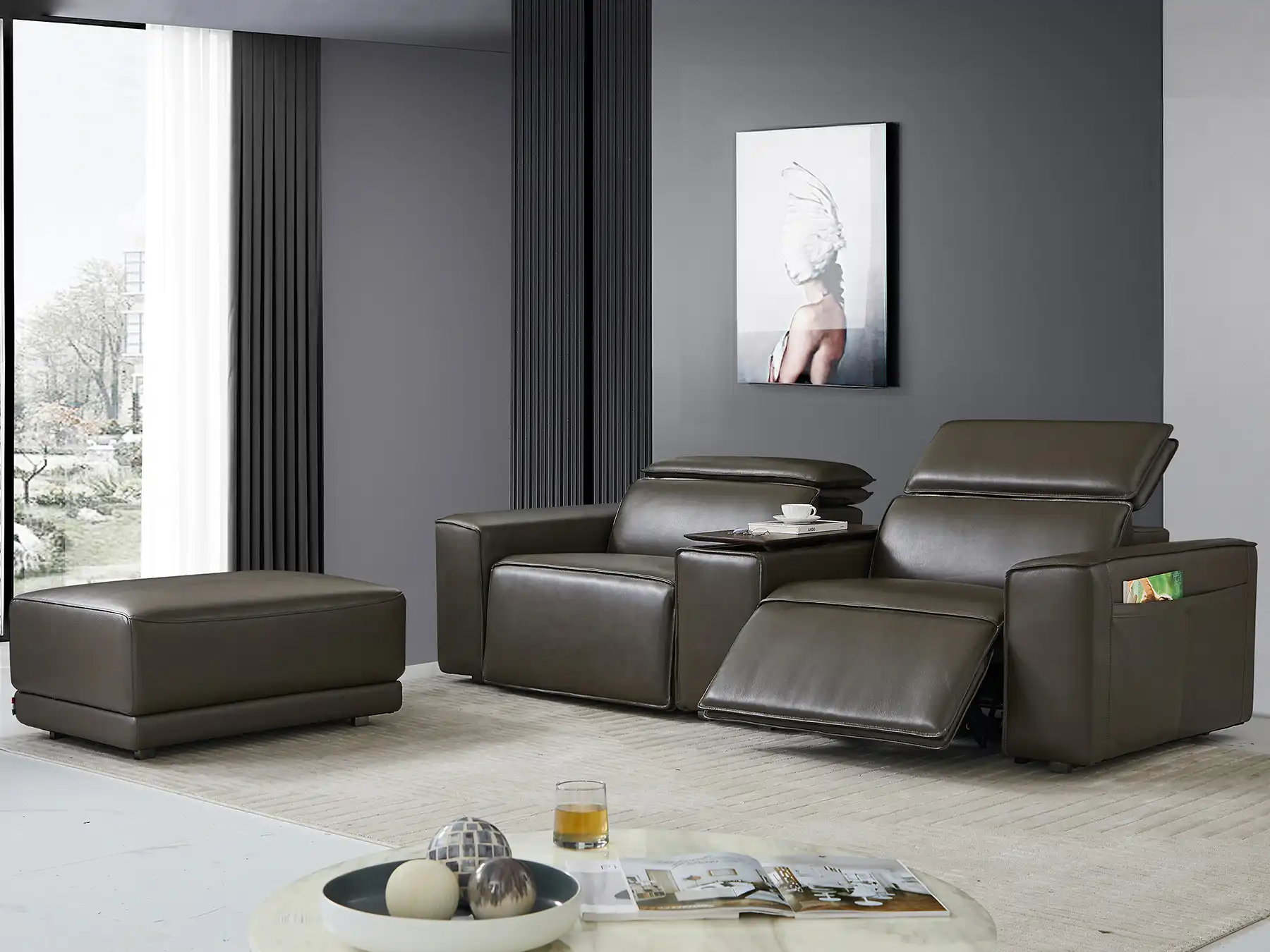
Making a structured seller evaluation matrix helps make difficult purchasing choices more objective. Depending on your goals, you can give different score factors different amounts of weight. For example, product quality might be worth 35% for high-end hospitality projects, while cost might be more important for value-oriented retail chains at 40%. When start dates are tied to yearly marketing plans or project finish schedules, lead time reliability should be given a lot of weight (20–25%). Customization response (15–20%) is most important for brands that set themselves apart with unique Power Recliner Sectional designs.
To judge the quality of a product, you need to look at more than one example unit, not just one highlight piece. Ask for samples from different production runs to check for stability, and test them for accelerated wear that makes them last for years in just a few weeks. Testing the longevity of a mechanism means turning it over and over again between the recline and return settings while keeping an eye out for noise buildup, binding, or alignment drift. When testing upholstery, leather samples are flexed to see if they crack, common substances are used to see how well they fight stains, and color fastness is tested by exposing the samples to UV light.
Budget Optimization Without Compromising Standards
Cost analysis looks at more than just unit prices. It also looks at total landing costs, which include freight, taxes, storage, and fixing any quality problems that might come up. Ocean freight rates change with the seasons. Shipments from China to the U.S. Depending on the market, West Coast ports charge between $2,000 and $6,000 per 40-foot container. Under most-favored-nation status, duty rates on cushioned wooden furniture under HTS code 9401.61 are currently 0%. However, policies can change at any time.
Negotiating payment terms has a big effect on how much working capital is needed. Standard 30% payment and 70% balance against a copy of the bill of lading protects both parties, but it means that a lot of cash has to be spent before the sale is realized. If your first sales go well, you may be able to get net-30 or net-60 terms that let you pay as your product turns over. Letter of credit agreements through well-known banks protect foreign transactions and show sellers that you are financially stable.
Volume commitment rewards need to be looked at in detail. Suppliers often offer 5–10% lower unit costs in exchange for yearly volume promises. However, these deals require accurate demand predictions and may make it harder to respond to changes in the market. Talk about different price levels that will award growth without making too many promises up front: level one for 100 to 500 units per year, level two for 501 to 1,000 units, and level three for volumes over 1,000 units.
Conclusion
To find customizable Power Recliner Sectionals that work, you need to find a good balance between technical understanding and smart relationships with suppliers. Because these products are so complicated—they combine electrical systems with finely crafted furniture—they need to be made by companies that can show they are good at engineering and committed to quality. When you make buying decisions today, they set the tone for customer happiness and brand image, whether you're furnishing hotels, providing retail channels, or creating exclusive product lines. You can protect your investment and give your business a competitive edge in crowded markets by doing your research before choosing a provider, making sure specifications are clear, and using organized quality assurance processes.
FAQ
Q1: What are typical lead times for customized power recliner sectional orders?
A: OEM changes usually take between 8 and 12 weeks to make, from the time the deposit is confirmed until the container is loaded, as long as the materials are in stock and no design engineering is needed. This time frame is stretched out to 16–20 weeks for ODM custom development, which includes testing, sample approval changes, and making the tools. During busy production times (July to September for holiday stocking) lead times may be extended by two to three weeks.
Q2: Can I mix different upholstery materials within a single order?
A: Once the minimum numbers for each specification are met—usually 20 to 50 units per unique SKU, based on how complicated the material is—most makers can fill orders for mixed materials. Because of differences in pattern and cushion core, it's harder to combine leather and fabric types within the same sectional arrangement.
Q3: What warranty coverage should I expect from quality suppliers?
A: Standard guarantees for Power Recliner Sectionals cover production flaws for 3 to 5 years on the frame and mechanism parts, 1 to 2 years on the electrical motors and control systems, and 1 year on the upholstery materials. Some high-end makers cover mechanisms for life on frames and for 10 years on reclining mechanisms. This shows that they are confident in the quality of the building.
Q4: How do I verify compliance with U.S. and European safety standards?
A: For example, in the United States, you can ask for copies of test results from approved labs that show the product meets the requirements of BIFMA X5.4 for office seating in business settings, 16 CFR 1633 for flammability requirements in homes, and EN 1728 for durability testing in European markets. Suppliers who offer ongoing compliance testing programs instead of one-time licenses show that they are more committed to quality.
Q5: What minimum order quantities apply to customized specifications?
A: MOQs change a lot depending on how much customization is done. Simple changes to current designs that use different materials usually need 50 to 100 units per setup. Because of changes in dimensions that affect frame building, MOQs need to be raised to 100 to 200 units in order to support tooling adjustments. To cover the costs of engineering, testing, and special tools, fully custom ODM development usually needs 200 to 500 pieces.
Q6: How can I manage quality consistency across multiple production batches?
A: Setting up approved golden samples that are kept on file with the maker gives future production runs a way to compare themselves to past runs. Detailed standard sheets with pictures of acceptable limits stop production teams from having different ideas about what they mean. Putting inspection checks in place at the stages of receiving raw materials, mid-production assembly, and pre-shipment finds mistakes before they affect large amounts.
Partner With Kanas Furniture for Your Power Recliner Sectional Supply Needs

Choosing where to get your products affects their image and how much money they make for years to come. Kanas Furniture is ready to be your reliable Power Recliner Sectional provider. They offer both advanced production skills and open customization services that are tailored to your market placing. Our 40,000㎡ factory in Foshan uses strict quality control methods that meet ISO 9001 standards. Our track record of working with Walmart and Costco as partners shows that we can handle the needs of demanding retail settings.
Our engineering team creates solutions that balance quality, style, and cost whether you need OEM changes made to our current designs or full ODM creation of new collections just for you. We know how complicated international business-to-business buying can be, from making sure materials are compliant to finding the best ways to use containers, and we can keep projects on track by communicating quickly and clearly. Contact our export team at sc@kanasfurniture.com to talk about your specific needs, get full specs, and receive personalized quotes that show how working with an experienced Power Recliner Sectional manufacturer can help your business compete.
References
1. Miller, D. & Thompson, R. (2022). Modern Furniture Mechanisms: Engineering and Design Principles for Motion Seating. Furniture Design Press.
2. International Furniture Supply Chain Institute. (2023). Global Sourcing Standards for Commercial Upholstery: A Procurement Guide. IFSCI Publications.
3. Chen, L. (2021). "Quality Assurance Protocols in Cross-Border Furniture Manufacturing." Journal of International Trade and Manufacturing, 15(3), 287-312.
4. North American Furniture Testing Consortium. (2023). Compliance Requirements for Upholstered Furniture: United States and Canadian Markets. NAFTC Technical Standards Division.
5. Williams, S. & Patterson, K. (2022). Hospitality Furniture Specification: Durability, Aesthetics, and Procurement Strategies. Commercial Design Publishing.
6. European Furniture Manufacturers Federation. (2023). Technical Standards and Certification Requirements for Motion Furniture in EU Markets. EFMF Regulatory Guidelines.
_1750820218660.webp)
Learn about our latest products and discounts through SMS or email